
Batteries are widely used to power a range of devices and machinery. Their use in boats and cars is most common. However, marine batteries are generally compared with car batteries. This comparison sparked a debate over marine battery vs car battery. Many people ask if they can use marine and car batteries interchangeably.
Interestingly, marine and automotive batteries are very different. Their structure, build, and overall performance differ significantly. As a result, using marine batteries in cars may not be the best option. In this article, I will discuss all the differences between car and marine batteries. Let’s get started.
Differences Between Marine Battery and Car Battery
Before discussing differences, note that marine or boat batteries are the same. Two names are used for one type of battery. Similarly, car batteries are the same, as they are designed to provide a quick burst of energy to start the engine. Let’s explore further and learn about the differences between these types of batteries.
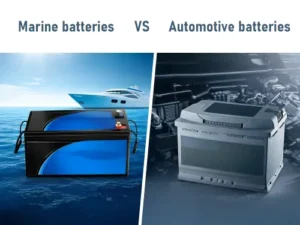
1- Function & Usage
Car batteries are not very versatile, and they perform a single function. They provide the sudden energy burst needed to start the car’s engine. Once the engine is started, the battery has no other work to do. The reason is that the alternator system takes over, charging the battery as well as powering other parts of the car. In other words, car batteries are designed only to start the car’s engine.
On the other hand, marine or boat batteries perform a dual function. First, they provide high energy quickly to start the engine of the boat. Once the boat is started, the batteries do not stop working. Instead, they offer steady energy, ensuring that all the boat’s components remain functional. These include GPS, radio, lights, and sensors to keep the boat operational. These batteries can consistently power the components for many hours.
2- Design & Construction (Build)
Car batteries are typically simpler in design and construction. They come with multiple lead plates, which are very closely packed together. Having multiple plates helps these batteries produce high-energy bursts easily. However, thin plates are not suitable for delivering power over extended periods.
Additionally, these batteries have conventional, round-shaped terminals. You can clamp the wires around these rounded terminals. Conversely, lead-acid marine batteries also use lead plates. However, the number of lead plates is fewer than that of car batteries, and the plates are much thicker. These plates are spaced apart, not closely packed.
As I said above, these lead plates are thicker in marine batteries. So they provide sudden energy bursts, as well as steady power to the boat’s components for extended periods. When it comes to terminals, the boat batteries have both round and threaded terminals. Remember, dual terminals let you power multiple components simultaneously with these batteries.
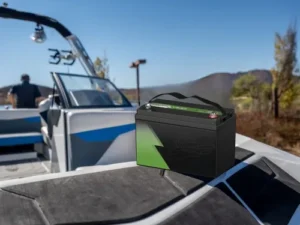
Quick Highlight: AGM and lead-acid marine batteries have lead plates for their operation. However, lithium marine batteries don’t have lead plates. Their operation is based on lithium-ion transfer between electrodes. The batteries are more expensive, but compact and very lightweight compared to lead-acid marine batteries.
3- Durability & Vibration Resistance
Automotive batteries are less durable and less robust in terms of vibration resistance. The reason is that these batteries are designed for use in vehicles. These vehicles run on roads, so batteries are not exposed to harsh shaking. Thinner lead plates can be damaged if batteries are exposed to harsh vibrations.
However, they are only made to withstand mild vibration produced when a vehicle runs on the road. On the opposite side, marine batteries are used in boats. These boats are exposed to harsh waves, tides, and extreme vibrations. Manufacturers generally make them more robust to withstand these harsh vibrations. Their thicker lead plates remain in good form even when exposed to shaking.
4- Discharge Type & Depth of Discharge (DoD)
Car batteries come with a shallow discharge system. This means these batteries are not discharged completely. The reason is that they are not used to starting the car’s engine. Once the engine is ignited, the charging system takes over and charges the battery. Only 10-15% of the battery’s capacity is used during starting.
On the other hand, marine or boat batteries feature a deep-discharge system. These batteries not only start the engine but also power the boat’s components for longer periods. The power stored in these batteries is constantly used during the boat’s operational hours. Marine batteries can safely use 60-80% of their stored energy before recharging. In other words, they are deep discharging with a higher depth of discharge (DoD).
5- Recharge Cycles & Operating Environment
Car batteries come with fewer recharge cycles. This might sound like a drawback, but it isn’t, since these batteries are rarely fully discharged. Remember, a recharge cycle is one cycle in which batteries fully charge and discharge. The car batteries start the engine, and then the vehicle’s charging system fully recharges them.
So it is not always used 100%. Even with fewer recharge cycles, these batteries offer optimal lifespan. On the other hand, marine batteries have more recharge cycles. They are always discharged to the maximum extent as they are used more aggressively. Remember, their role is to start the boat’s engine and then also power the accessories. So, they are discharged completely more often.
Higher charge cycles help boat batteries remain functional for years. Car batteries are for moderate conditions. However, they cannot withstand prolonged exposure to moisture. On the other hand, marine batteries are exposed to conditions such as moisture, water, and changing temperatures. Manufacturers use strong materials that withstand harsh conditions for the longevity of batteries.
6- Size & Weight
Boat and automotive batteries differ in size, dimensions, and weight. Car batteries are generally very compact so that they can fit in the tight space in the car. Additionally, their weight is also very low compared to marine batteries. The reason is that these batteries have thin lead plates, which make them lightweight.
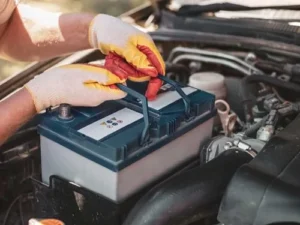
Additionally, they don’t have a strong metal casing, which could have increased the weight. In contrast, marine batteries are heavier, bulkier, and larger. The reason is that they have thicker lead plates, which increase the weight. Additionally, these plates are spaced apart by some distance. This distance between plates requires more space, which in turn makes the batteries bigger.
7- Initial Cost & Maintenance
Car batteries are way cheaper than marine batteries. Why? The reason is that these batteries are made to start the engine only. They are single-function batteries that require thin plates. Making a thin lead plate is easier and reduces material cost. Additionally, there is no specific maintenance cost except for checking the water level.
On the other hand, marine batteries are very expensive. The reason is that these batteries come with thick lead plates. Making these plates requires more materials, which increases the cost. Additionally, these batteries come with a strong casing to ensure security. However, this casing also contributes to the higher cost of the marine batteries. Not only the initial cost, but also the ongoing maintenance costs of these batteries are higher.
Can You Use a Car Battery in a Boat or a Marine Battery in a Car?
This is an interesting question, and the answer is yes. Technically, you can use both batteries interchangeably. The boat battery will start the car’s engine. On the other hand, the car battery will start the boat. However, they are not recommended and should not be used interchangeably. In an emergency, a marine battery can only be used to jumpstart the car.
As I said earlier, car batteries are designed to deliver quick bursts of energy to start a car’s engine. After this, these batteries are not used, and the car’s charging system starts recharging the battery. However, boats require both quick bursts of energy and steady power for accessories. When you use a car battery on a boat, it starts the boat’s engine.
However, these batteries are designed for quick bursts, not for steady power delivery. So these batteries will overheat and deteriorate when used for powering the boat’s components for a long time. Similarly, marine batteries can provide a burst of energy to start a car’s engine. However, these batteries are larger and may not fit in the limited space in cars. If your car battery is dead and you need to jumpstart your car, marine batteries can help.
You can use a marine battery to start the car’s engine. The battery will remain outside the car, and the engine will start. Once the car’s engine is started, you can remove the marine battery and use the car battery. The car’s charging system will start charging the dead battery and restore it to functionality. In other words, jumpstarting the car in an emergency is possible with marine batteries. However, using a car battery in a marine vehicle (or vice versa) is not the best option.
Frequently Asked Questions
Can I jumpstart my car with a marine battery?
Yes. Marine batteries can provide a quick, higher-energy burst. This energy can effectively jumpstart the car’s engine. In fact, you can also use a car battery to jumpstart a boat engine as well.
Can I use a marine battery charger to charge a car battery?
Yes. You can use a marine battery to charge a car battery. The marine battery charger is more advanced with a smart control system. So, it will charge it without overheating and at a moderate speed.
Are marine batteries better than regular batteries?
Marine batteries are unique as they are more powerful and provide consistent power. Comparing it with a regular battery is not ideal. Regular batteries are generally designed to provide a high-energy burst. Marine and regular batteries differ in many aspects, including the ideal use cases. You should choose a marine battery for boats.
Conclusion
Many seem confused about choosing between marine and automotive batteries. That’s mainly because of a lack of information about these two types. It is worth noting that both batteries are highly specialized in their functionality. You should choose marine batteries for boats or smaller yachts.
On the other hand, car batteries are suitable for cars and other automobiles. The marine battery serves a dual purpose: providing a quick energy burst and a steady power supply for accessories. On the other hand, car batteries only provide a burst of energy to start the engine. Still, they are charged while the engine is running and recharged by the car’s charging system. In this article, I have discussed all the key differences between marine and car batteries.