
Often, when you start your car, one question that might come to your mind is: Is a car battery AC or DC? Actually, cars depend on electricity every time you start the engine or turn on the headlights. Many of you know that behind all these functions, there is a battery. However, there is confusion about whether that battery provides DC or AC power for these functions. If you are also confused, you are not alone. But worry not! In this guide, I will answer this question logically and help you understand how your car battery actually works. So let’s get started.
What are AC and DC?
AC (Alternating Current) is a type of electricity that changes its direction many times every second. Instead of flowing in one fixed direction, it moves back and forth continuously. This wave motion makes it easier to send electricity over long distances with less power loss.
Alternating current is what you use in your home, offices, and most other buildings. It runs all the electric devices in your home. The best thing about AC is that it can travel efficiently over long distances through power lines. That is the reason it is the preferred choice for delivering electricity from power plants to homes and businesses around the world.
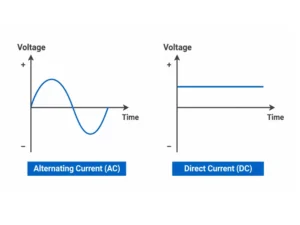
DC (Direct Current) is a type of electricity that flows in only one direction. It provides a steady and continuous flow of electrical power without changing direction. This stable flow makes it ideal for devices that need consistent voltage.
DC is generally not suitable for long-distance travel. However, in battery-powered devices, DC is preferred. The reason is that it provides the reliable, stable power these devices need. Electricity always flows in one direction. So, electronic components receive a consistent power supply. This enhances the efficiency of electronic devices like smartphones, laptops, and power banks.
Is a Car Battery AC or DC?
A car battery uses DC (Direct Current) electricity. It sends electrical power in one steady direction. This is exactly what a vehicle needs to start the engine and run its electrical systems. Whether it is a 12-volt car battery or an auxiliary battery, the battery always supplies DC power, not AC.
Basically, in car parts, a battery is the main source of electrical power. Before the engine starts, the battery supplies the electricity needed to crank it. It supplies power to important electrical components. Even after you turn off the engine, you can still turn on the interior lights, clock, and security system.
All this becomes possible because of a battery that delivers DC and still works behind the scenes. So, without DC, any electrical component of the car will not work. Many people still confuse a car battery with other electrical parts found in a vehicle. But remember, different components work together to keep the electrical system running smoothly. Among those, the battery itself always supplies DC power.
Why Does a Car Battery Use DC Instead of AC?
Now you have a clear idea that a car battery is always DC. But why? There are several reasons that explain it. First of all, inside the battery, a chemical reaction creates electrical energy. This process naturally produces DC instead of AC. That’s why all standard car batteries are designed to provide DC power.
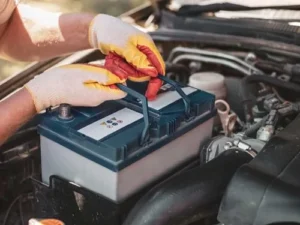
Another reason for DC is that it is a steady current and flows only in one direction. This stable power supply is very important for the working of several important vehicle systems. For example, when you turn the key or press the start button, the battery must immediately send power to start the engine. That power turns on the headlights, dashboard, radio, and other electronic systems. Without DC, none of this would be possible.
Lastly, a car battery uses DC because it must store electrical energy for later use. AC is mainly for transmitting electricity, not storing it. So that’s DC, which can be easily stored inside the battery until it is needed. After the car is parked, the battery keeps this power inside so it is ready to start the engine the next time you drive. Also, this stored power can turn on several features even when the engine is off.
If the Battery Is DC, Why Does a Car Have an Alternator?
Yes, there is no doubt that the car battery is always DC, but it still has an alternator. This alternator basically performs some important functions. Actually, the car battery supplies DC power, but it cannot keep providing this electricity forever. Every time you start the engine or use electrical features, the battery loses some of its stored energy.
Now, if the battery were the only power source, it would eventually run out of charge, and the car would no longer start. Right? That’s where an alternator comes into the scene. This alternator starts working as soon as the engine is running. Its main job is to produce electricity while the car is being driven. This electricity is continuously supplied to the car’s electrical components while it is running.
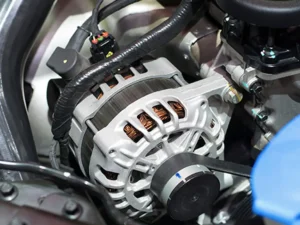
It means the stored energy remains there and is not used at that time. Only the alternator’s electricity is used when the car is running. At the same time, alternators also replace the energy that the battery uses. This keeps the battery charged and ready for the next engine start. In simple terms, the battery and alternator work as a team. The battery provides the electrical power needed to start the car. However, the alternator takes over once the engine is running to provide power.
How Does the Alternator Convert AC into DC?
As I said above, when a car engine starts, it turns the alternator via a belt. But this alternator generates AC (alternating current). Now, the problem is that most of the car’s electrical components require DC, not AC. So it is necessary to convert this AC to DC, right? The alternator itself performs this function. How?
Actually, there is a part called a rectifier inside the alternator. The rectifier contains small electronic parts called diodes. A diode works like a one-way gate for electricity. Now, when AC passes through these diodes, they allow electricity to move in only one direction and block it from flowing back the other way. After this process, the electricity no longer keeps switching directions and becomes DC.
Once the electricity has been changed into DC, it goes to the voltage regulator. The regulator ensures the voltage stays within a safe range so the battery and other electrical components are not damaged. The DC electricity is then used to recharge the battery and power the car’s electrical parts.
Are There Any Parts of a Car That Use AC?
Yes, some parts of a car use AC (Alternating Current), but not the car battery or most of the vehicle’s electrical system. In a standard gasoline or diesel car, the main part that uses AC is the alternator. It first generates AC, then converts it to DC. Secondly, in some electric vehicles (EVs), the electric motor also uses AC to drive the wheels.
Some cars also have a power inverter, which changes the battery’s DC power into AC. This allows devices such as laptops, phone chargers, small TVs, and portable fans to be used. In many modern electric vehicles, AC motors are used to drive the wheels because they are efficient, powerful, and easy to control. So, mainly it is DC that powers the battery’s electrical parts. However, AC works with DC to some extent.
Frequently Asked Questions
Can a dead battery in a car still produce voltage?
Yes, sometimes a dead battery produces voltage. However, this voltage is so low that it is usually not enough to start the engine or power the car properly.
Do electric cars use AC or DC?
Yes, electric cars use both AC and DC. Their battery stores DC electricity. However, many electric vehicles use an AC motor to drive the wheels. The vehicle automatically converts the electricity when needed, so both types work together.
Can a car battery power home appliances?
Yes, it can, but not by itself. A car battery needs a power inverter to convert its DC electricity into AC electricity before it can run most home appliances. However, it is only suitable for small appliances and for a very short time.
Can solar panels charge a car battery?
Yes, solar panels can charge a car battery. But it should first be connected through a solar charge controller to charge the battery safely and prevent overcharging.
Conclusion
Let’s conclude: A car battery is always DC, not AC. The reason is that DC flows in a single, steady direction, not in a wave motion like AC. This steady power is needed for all the battery’s electrical components to operate. Moreover, DC can be stored to start the engine again after the car is parked. This stored energy also activates car features, like headlights and security systems, even when the engine is off. Also, inside the battery, a chemical reaction naturally produces DC electricity. However, the alternator inside the car generates AC, which is quickly converted to DC by rectifiers. So overall, a car battery is DC, powering the engine and other components.