
With today’s battery tech, lithium-ion cells are safer and more efficient than ever. They power everything from phones to laptops to EVs. That’s precisely why safety still matters so much. Do lithium batteries leak like regular alkaline batteries? No, not in the normal sense of the word. Alkaline batteries leak corrosive potassium hydroxide when they go bad. Lithium-ion cells are fully sealed with no free-flowing liquid inside. Under normal use and storage, they do not leak. However, leaks can still occur if the battery structure is damaged. A lithium battery “leak” occurs when electrolyte escapes from a sealed battery. While not highly corrosive, it is toxic and flammable, so it requires careful handling.
This article covers the real failure signs, what actually causes venting, and — most importantly — how to prevent it in the first place.
What Is Lithium-Ion Battery Leakage?
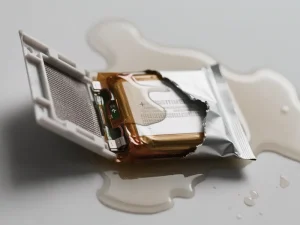
Lithium-ion battery leakage refers to the accidental leakage of the electrolyte from the sealed casing of a lithium-ion battery. This is different from traditional alkaline battery leakage.
Alkaline batteries often leak corrosive potassium hydroxide as they age.
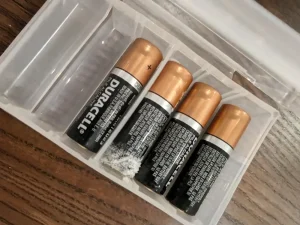
Lithium batteries are sealed systems designed to prevent electrolyte leakage during regular operation. However, lithium batteries can still leak or vent, especially under stress conditions such as overheating, impact, or internal short circuits.
Signs of Lithium-Ion Battery Leakage
If your products exhibit any of the following signs, please examine their lithium-ion batteries. Because they indicate lithium-ion battery leakage.
Visual Signs
- Colorless to pale yellow, oily or viscous liquid on the battery surface. Or, there are white or blue-green powdery and velvety crystalline substances.
- The battery appears to be bulging or swelling. This is a hazardous sign. The internal pressure increases, and the battery casing becomes deformed or ruptures. Finally, it leads to a rupture of the seal and liquid leakage. What’s more, it is dangerous if battery outer cases show signs of corrosion, rust, or small holes.
- Green/blue corrosion or white powder appears on the metal contacts of the battery compartment. There are abnormal stains or corrosion marks on the circuit board inside the equipment.
Olfactory Signs
You can smell a sweet or fruity chemical smell if a lithium-ion battery leaks. Take it seriously, even if you do not see the electrolyte.
Equipment Performance
- The device fails to work or works unstably. The device frequently fails to turn on or shuts down automatically.
- The battery performance has declined. The battery life declines sharply. Besides, there is abnormal heat during charging.
- The battery becomes abnormally hot. When the battery is idle or in use, it may overheat or feel hot to the touch.
Why Does a Lithium-Ion Battery Leak?
- Expired or stored for a long period. Even when the battery is not in use, its internal components can undergo a slow chemical reaction to produce gas. Then, the internal pressure increases, causing the battery to bulge or swell.
- Poor-quality battery. The sealing process of inferior batteries is poor, and they are prone to leakage.
- Short circuit. The positive and negative terminals of a battery accidentally connect with a metal object, which can cause a sudden, large current discharge. So, it can generate a large amount of heat and gas, which can lead to leakage or explosion.
- Over discharge. After the device has completely drained its battery, the battery’s internal components can undergo an irreversible chemical reaction that generates gas, leading to leakage.
What Should You Do if a Lithium-Ion Battery Leaks?
- The leaked electrolyte vapor is harmful to humans, so open windows to ventilate the area immediately.
- Electrolytes are corrosive, so put on protective gloves and safety goggles.
- If the battery is in the device, turn off the device’s power immediately.
- Move the battery to a safe, open area to keep it far from flammable materials.
- It is essential to seal and professionally recycle waste batteries. The battery must be sealed in a bag and taken to a professional recycling facility.
- If the battery is smoking or catching fire, use a Class D fire extinguisher (specifically for metal fires) or dry chemical extinguishers. Never use water — it can cause a violent reaction or explosion.
How to Prevent Lithium-Ion Battery Leakage?
Prevent physical damage
Avoid collisions, drops, compression, or punctures with lithium-ion batteries. Piercing the battery with sharp objects is the most direct cause of immediate leakage and short circuit. So, be careful when you install and remove batteries.
Avoid overcharging and overdischarging
Firstly, use original or certified chargers.
Secondly, avoid leaving the device on the charger for extended periods.
Thirdly, don’t wait until the battery is completely shut down before charging.
Control temperatures
Avoid high temperatures. Don’t leave your device in direct sunshine or a hot car. Don’t place the battery near a fire or a heat source.
Avoid low temperatures. Low temperatures easily cause internal circuitry issues, which in turn lead to thermal and leakage issues.
Store properly

If the battery is not used for a long time, it should be charged to 40%-60% of its capacity.
Store lithium-ion batteries in a cool, dry place.
Do not store batteries with metal objects together.
Check regularly
Check the battery’s appearance. If there is bulging, deformation, cracking, abnormal spots, or the leakage of sticky liquid, stop using it immediately.
Conclusion
In summary, lithium-ion batteries have the risk of leakage. Through this article, you learn the steps you can take if a leak occurs. Take any swelling or unusual smell very seriously
Although you know the strategies for responding to electrolytes, the best approach is to prevent them. Choosing high-quality lithium-ion batteries can reduce the risk.